
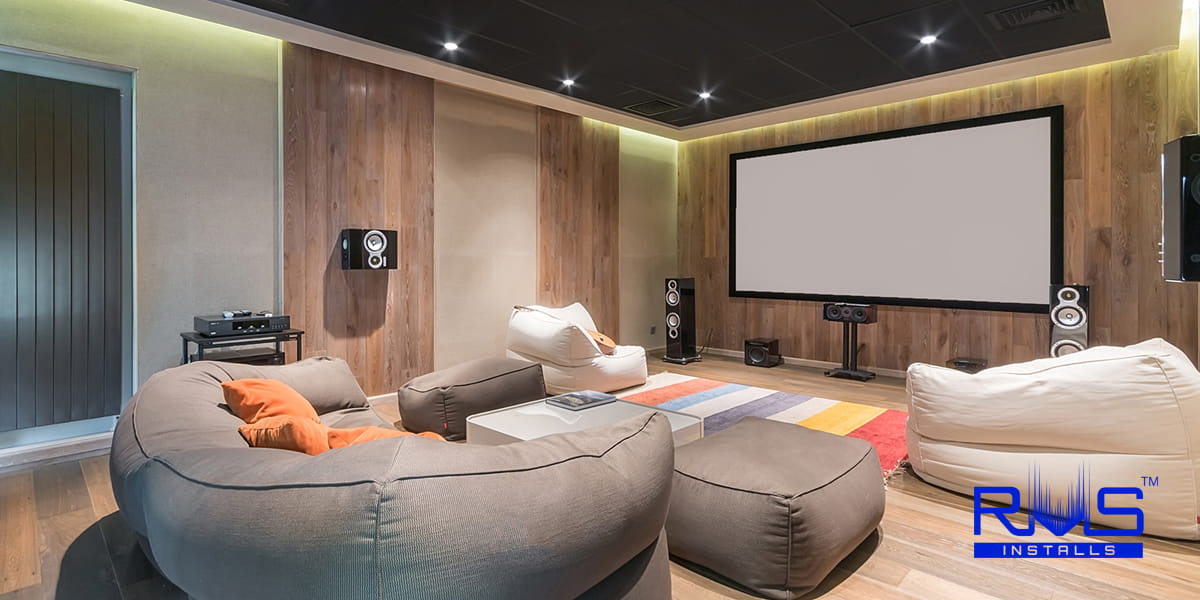
Best Subwoofer Placement for Powerful Home Theater Sound
Getting the bass right in your home theater setup transforms the whole experience. Subwoofers handle those deep low-frequency sounds under 100 Hz, creating that chest-rumbling effect during action scenes. How you position them makes a big difference, which is why knowing where to place a subwoofer in home theater is important.
Poor placement can create boomy spots or weak zones, while the right spot delivers smooth, powerful sound without extra treatments. Low frequencies bounce off walls and create standing waves that affect clarity, so optimal placement improves dynamics, immersion, and even helps prevent rattles that disturb neighbors.
Learn key insights and important facts about setting up your home theater with proper installation tips.
How Subwoofers Work
Subwoofers turn electrical audio signals into deep bass you can hear and feel. The process starts with low-frequency signals from your source. These go to the subwoofer's built-in amplifier. It boosts the voltage and current. This energizes a voice coil inside a strong magnetic field.
The coil moves back and forth with the signal. It attaches to a large cone or diaphragm. That cone pushes and pulls air to make pressure waves. These waves are the bass sounds. At very low frequencies like 20 Hz the wavelengths can stretch up to 56 feet. That's about the size of a room. Bass spreads out in all directions. It reflects off surfaces. Those reflections can add up or cancel out based on distances. That's why where you put the sub changes everything. It controls those wave interactions for better sound.
Why Placement is Key
Where you place your sub affects bass evenness across seats. Low frequencies hit room boundaries hard. This creates room modes with peaks and nulls. Bad spots mean uneven sound and lost power. Good ones improve clarity and blend with the rest of your system. In home theaters this means accurate punchy bass. It pulls you into the action without distortions.
Where to Place Subwoofer in Home Theater - Single & Multiple
Single Subwoofer Placement
For one sub start with basic rules to avoid common problems. Use the rule of thirds. Put the sub one-third or one-fifth of the room's depth from the front wall. This skips exciting main room modes. Keep it at least 12 to 18 inches from walls or corners. Close spots build up too much bass. Line it up vertically with your front speakers. This keeps the phase in sync for smooth sound.
Try the subwoofer crawl for the best results. Put the sub in your main listening seat. Play something with heavy bass. Crawl around the room's edges at the sub's height. Listen for the smoothest fullest bass. Note those spots. Then move the sub there.
Here's a quick look at common single sub positions:
|
Position |
Pros |
Cons |
|
Corner |
Strongest output from wall support |
Can get boomy |
|
Front wall near main speakers |
Blends well for unified sound |
Less power than corner |
|
Center of room |
Avoids some boundary effects |
Often weak or uneven |
|
Behind seating |
Easy to hide |
Can cause dead zones |
|
Inside cabinet |
Out of sight |
Muffles sound badly |
Avoid the center behind seats or cabinets. These weaken bass or make it spotty.
Multiple Subwoofer Placement
More subs mean smoother bass overall. Two subs cut down on room mode issues. Place them opposite each other for balance. Try sides of the front wall or midpoints on side walls. Diagonal corners work great if your receiver adjusts distance and phase separately. Front-right and back-left is a solid choice.
For four subs use all corners. This averages out modes for flat response. Or pair them at midwalls on opposite sides. That's good for rectangular rooms. Calibrate with your system's tools for odd setups.
Check this table for dual sub ideas:
|
Setup |
Description |
Benefits |
|
Diagonal corners |
One front-right one back-left |
Fixes modes for consistent bass |
|
Center front wall |
Both along front center |
Smooth output easy speaker blend |
|
1/4 or 1/3 along walls |
On front and side walls |
Balances power and evenness |
|
Next to each other |
Close together |
Can cancel out bass |
|
One near one far |
Uneven distances |
Leads to weak spots |
Skip placing them right together or with big distance gaps. Those cause cancellations.
Pro Tips from Experts
Experts test spots to find the sweet ones. They skip default corners because of too much buildup. Instead they analyze room acoustics. Use sound level meters for checks. Long cables help with testing. Calibrate at ear level for best integration. Focus on even spread over max volume. In square rooms go asymmetric to fight odd modes.
Read our complete guide to home theater setup: What Do You Need For Home Theater Set Up?
The Subwoofer Crawl Step by Step
This technique helps you find the best place for your subwoofer just by listening. It works well because bass sounds different in various parts of the room. You do not need fancy tools. Anyone can try it at home. It takes some time but gives great results. Follow these steps carefully. Adjust as you go since no two rooms are the same.
-
Set up the subwoofer in your main listening spot
Start by putting the subwoofer right where you sit to watch movies or listen to music. This is often your favorite chair or couch spot. Raise it to the height it will be when placed on the floor later. Use a box or stand if needed to match that level. Connect it to your system like normal. Turn it on and make sure it plays sound. This step flips the usual setup. It lets you hear how bass reaches your ears from different room areas.
-
Choose a song or sound with strong low bass and play it on repeat
Pick music that has deep rumbling bass. Think of tracks with heavy drums or low notes. You can also use a test tone around 40 to 80 Hz if you have one. Apps or online tools offer free bass tests. Set your system volume to a comfortable level. Not too loud to hurt your ears but enough to feel the bass. Loop the track so it keeps playing without stops. This helps you focus on listening as you move around.
-
Get on your hands and knees to stay at the subwoofer's height
Lower yourself to the floor. Keep your head at the same level as where the subwoofer will sit. This is key because bass waves act differently near the ground. Crawling puts your ears in the right position. Wear comfy clothes. Take your time. Do not rush this part. It might feel silly but it works.
-
Move slowly along the room's edges and listen with care
Start at one wall. Crawl bit by bit around the perimeter. Go near the walls but not too close if furniture blocks you. Pay attention to how the bass changes. In some spots it might boom too much. In others it could fade away. Stop and listen for a few seconds at each point. Note how the sound fills the space. Look for balance without weird echoes.
-
Find and mark spots where the bass sounds full, clear, and balanced
Listen for places where the low notes feel strong but smooth. The bass should hit evenly without getting muddy or thin. Muddy means it sounds blurry or too heavy. Thin means it lacks power. Use tape or a note to mark good areas on the floor. Try a few spots if more than one sounds okay. Pick the best one based on how even it feels. Avoid areas with weak or uneven sound.
-
Move the subwoofer to that spot and test it from your seat
Take the subwoofer out of the listening chair. Put it in the marked location. Sit back in your normal spot. Play the same bass track. Listen to see if the sound improved. Check for power and clarity. Make small moves like a few inches if it needs tweaks. Test with different music or movie scenes too.
If the bass still does not feel right repeat the process. Try other spots or adjust your system's settings. Rooms vary in shape and size so keep experimenting until it sounds great. This method often beats guessing and leads to better home theater bass.
Final Tuning Tips
After placement fine-tune for perfection. Grab a microphone and software like room EQ tools. Measure delays and levels especially with multiples. Adjust small bits. Try different positions. Rooms vary so what works in one might not in another.
Read our in-depth home theater setup guide for clear, step-by-step instructions. It helps you design a system that performs well in any room.
Frequently Asked Questions
Where should I place my subwoofer for the best bass in a home theater?
Does it matter which way a subwoofer faces?
Can placing a subwoofer in a corner improve sound?
Should a subwoofer be near the main speakers or seating area?
Will multiple subwoofers improve my home theater bass?
Conclusion
Great sub placement creates theater magic at home. To take it even further, consider fine-tuning your room with small adjustments in subwoofer distance, phase, and multiple-sub calibration to balance bass across all seats. Even minor tweaks can make a huge difference in clarity and punch.
If you want professional guidance, RMS Installs can help you find the perfect subwoofer placement and optimize your home theater system. Our team ensures smooth, even bass and immersive sound tailored to your room, so you get the full cinematic experience without guesswork. Contact us today at 470-456-3108 to schedule an expert setup or visit our website to learn more about how RMS Installs can set up your entire home theater.
Certified partners






Click Here to Fill The Form Online or Call us at:

| Monday | 08:00 AM - 06:00 PM |
| Tuesday | 08:00 AM - 06:00 PM |
| Wednesday | 08:00 AM - 06:00 PM |
| Thursday | 08:00 AM - 06:00 PM |
| Friday | 08:00 AM - 06:00 PM |
| Saturday | 10:00 AM - 05:00 PM |
| Sunday | (Closed) |